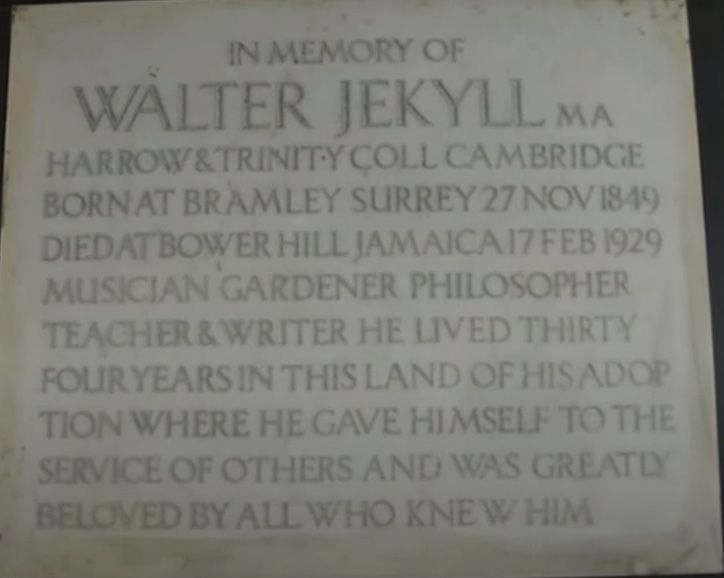
 Walter Jekyll (November 27, 1849 – February 17, 1929) was an English writer, polymath, and collector of folklore.
Queer Places:
Harrow School, 5 High St, Harrow HA1 3HP, United Kingdom
University of Cambridge, 4 Mill Ln, Cambridge CB2 1RZ
Hanover Parish Church, A1, Lucea, Jamaica
Walter Jekyll (November 27, 1849 – February 17, 1929) was an English writer, polymath, and collector of folklore.
Born into a prominent British family—his younger sister was the famous landscape designer Gertrude Jekyll—he was educated at Harrow School and Trinity College, Cambridge.
Jekyll was ordained as an Anglican priest, though he later abandoned the priesthood due to growing theological doubts and a turning toward agnosticism and Eastern philosophy.
Around the turn of the 20th century, Jekyll moved to Jamaica, settling in the Blue Mountains. There, he devoted himself to gardening, literature, music, and documenting local culture.
In 1907, he published Jamaican Song and Story: Annancy Stories, Digging Sings, Ring Tunes and Dancing Tunes under the auspices of the British Folk-Lore Society, capturing oral traditions, Creole dialect, and traditional songs.
Jekyll played a pivotal, transformative role in the early life and creative trajectory of Claude McKay, who would go on to become one of the premier poets of the Harlem Renaissance.
When McKay was an apprentice tradesman, Jekyll recognized his poetic talent. Crucially, Jekyll encouraged McKay to write poetry in Jamaican Patois rather than rigid Victorian English, helping finance and arrange the publication of McKay's breakthrough collection, Songs of Jamaica (1912).
Literary scholars frame Jekyll and McKay’s bond as a nuanced queer friendship grounded in intellectual intimacy, horticulture, and literature.
As scholar Wayne F. Cooper notes, McKay later hinted that Jekyll introduced him to "the reality and to the moral legitimacy of homosexual love," helping the young poet navigate his own sexual identity in a hostile colonial environment.
In a 1918 essay for Pearson's Magazine, McKay recalled the authors Jekyll introduced him to during their long conversations in the mountains. Significantly, McKay grouped together Walt Whitman, Edward Carpenter, and Oscar Wilde—three foundational figures in the late 19th- and early 20th-century homosexual/queer literary canon.
Jekyll remained in Jamaica until his death in 1929, leaving a legacy as both a preserver of Afro-Jamaican folklore and a liberating figure in McKay's personal and artistic development. Walter Jekyll’s estate in Jamaica was known as Bower Hill (also referred to in biographical records as Bower Hall). Bower Hill was located in or near Lucea, within the Riverside area of Hanover Parish, Jamaica. Jekyll originally lived in the Blue Mountains in eastern Jamaica, but after narrowly surviving a landslide during the 1907 Kingston earthquake, he relocated to the Hanover Parish in northwestern Jamaica. Bower Hill became a cultural hub where local residents gathered for Saturday morning music and literature seminars. It was also where Jekyll hosted and mentored Claude McKay and other young intellectuals. Jekyll lived at Bower Hill until his death on February 17, 1929, and was interred at the nearby Hanover Parish Church cemetery in Lucea.
References:
 Sex, Time and Place: Queer Histories of London, c.1850 to the Present Paperback – April 19, 2018 by Simon Avery and Katherine M. Graham |
Other references:
Support this project
This website is a passion project researched, developed, and funded entirely by me. If you find the content valuable and would like to help support the ongoing research and hosting costs, any contribution is deeply appreciated.
Thank you for keeping this independent resource alive!
My books on Amazon: Elisa Rolle's books